
The Ultimate Outdoor Fountain Sizing Guide: Scale, Proportion, and Placement
If you ask people what they worry about before ordering an outdoor fountain, they’ll usually say style, color, or the water sound. In reality, those almost never cause problems.
Size does.
We’ve had customers love a fountain online, unpack it, set it in the yard… and immediately know something was off. Sometimes it looked tiny and got swallowed by the landscaping. Other times it felt huge, like it landed in the middle of the patio and took over the whole space.
And because most outdoor fountains are cast stone or concrete, they don’t come in a small box. They arrive on a freight pallet, often weighing a few hundred pounds. At that point, exchanging it isn’t just inconvenient — it becomes a project.
The good part is this is very preventable. You can figure out the right size before you order with a tape measure and a simple trick designers use all the time: laying out the fountain’s footprint on the ground with cardboard. Once you actually see the space it will occupy, choosing the right fountain becomes much easier and far more confident.
Step 1: Measure the Space (Not Just the Empty Area)
Most people walk into their yard or patio, eyeball the open space, and think:
"Yeah… a 4-foot fountain should fit here."
But fountains don’t exist in empty space — they exist in relationship to furniture, pathways, doors, plants, and viewing angles.
Before choosing a fountain size, measure three things:
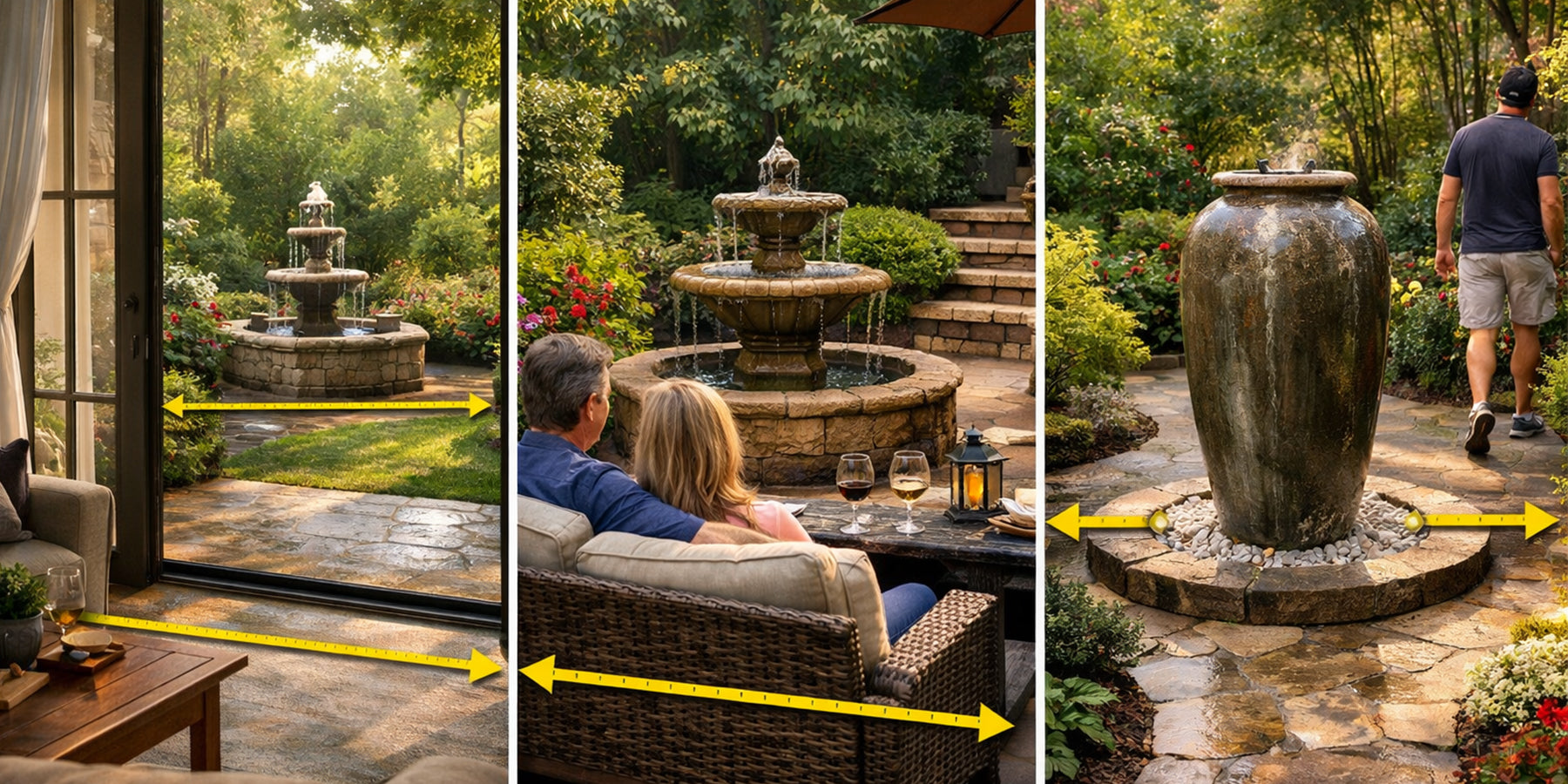
1. The Viewing Distance
Stand where you will most often see the fountain:
- inside your home (through a window or sliding door)
- patio seating
- outdoor dining table
- pool lounge chairs
Now measure the distance from that spot to the fountain location.
Why this matters:
Fountains are visual anchors. If the fountain is too small relative to the viewing distance, the water detail disappears and you’re left with what looks like a decorative object instead of a focal point.
Quick rule of thumb
- Viewing distance 6–10 ft → 24–36 inch tall fountain
- Viewing distance 10–18 ft → 36–48 inch tall fountain
- Viewing distance 18+ ft → 48–72 inch tall fountain
2. Walking Clearance
You also need walking space around it.
A fountain basin shouldn’t sit in a traffic lane. People will avoid it subconsciously, and the space will feel cramped even if it technically fits.
Maintain:
- Minimum clearance: 30 inches (tight patio)
- Comfortable clearance: 36–48 inches (ideal)
3. The Width of the Patio or Garden Bed
This is actually more important than height.
A fountain that is too wide makes a space feel crowded. Too narrow and it looks temporary — like it was placed there “for now.”
We’ll use this measurement in the next step.
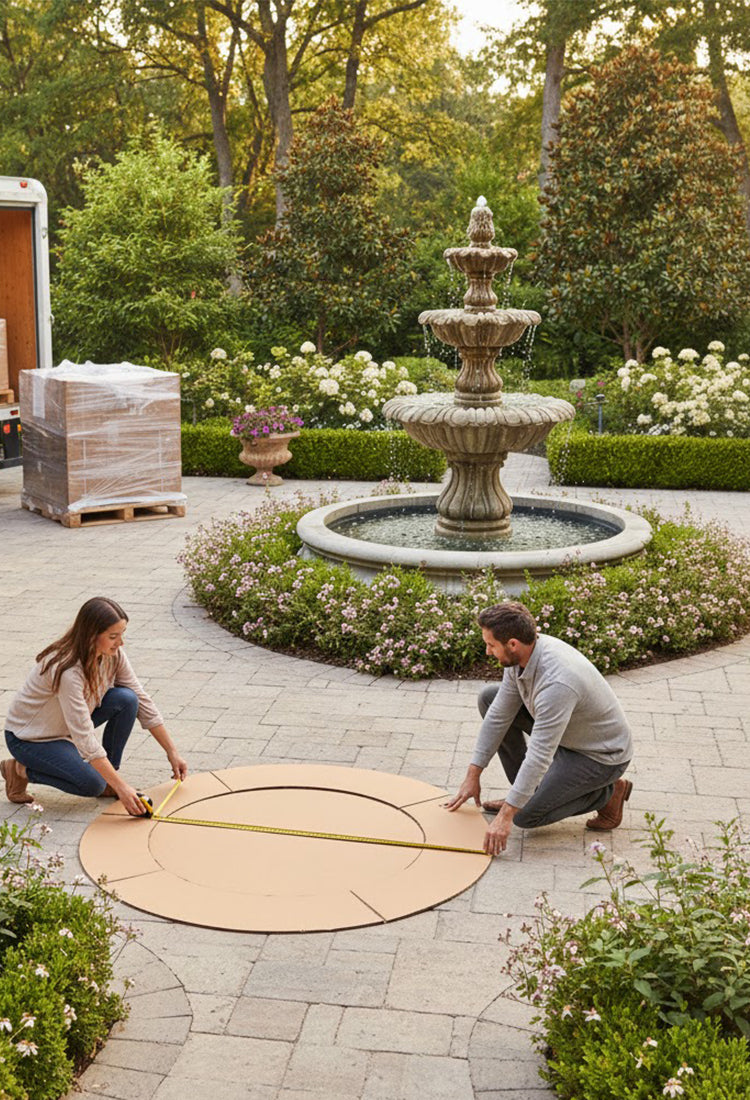
Step 2: The Cardboard Cutout Method (Professional Designers Use This)
Here’s the single best trick for choosing the right outdoor fountain size.
Create a full-scale mockup.
You don’t need design software.
You need cardboard, painter’s tape, and 10 minutes.
How to do it:
- Look at the fountain you want
- Find the basin width (the widest measurement)
- Cut cardboard to that exact diameter
- Tape it to the ground where the fountain will sit
Then — and this is important — live with it for a day.
Walk past it.
Sit near it.
Look at it from inside your house.
You will immediately feel one of three reactions:
• “That’s perfect.”
• “Wow… that’s way bigger than I expected.”
• “It looks smaller than I imagined.”
Your brain understands physical space far better than numbers on a product page. This one step prevents more fountain returns than any measurement chart ever could.
Step 3: Matching Fountain Basin Width to Patio Size
This is actually where most sizing regrets come from.
People tend to look at the height of the fountain first because that’s what stands out in photos. But once the fountain is in the yard, height isn’t what throws things off — the basin width is.
If the basin is too wide, the patio suddenly feels crowded and you start walking around it instead of enjoying it. If it’s too narrow, the fountain looks temporary, almost like it was placed there just to fill an empty spot.
What we’ve found works consistently is keeping the fountain around a third of the width of the space it sits in.
For example, if the patio area measures about 12 feet across, a basin close to 4 feet wide almost always feels right once it’s set in place.
There isn’t anything technical about this. It just matches how we read space. When the fountain fits the scale of the area, your eye relaxes. The seating arrangement looks more natural, the surrounding plants make more sense, and the yard stops looking like separate pieces and starts looking like a finished space — even though the only thing that changed was the size of the fountain.
Step 4: Avoid the Two Most Common Sizing Mistakes
Mistake #1: Buying Too Small
This is by far the most common regret.
Customers often choose smaller fountains because they worry a larger one will overwhelm the space or be too loud.
In reality:
- Water sound depends on water drop height and flow, not overall size
- A slightly larger fountain looks intentional
- A small fountain looks like décor
A fountain is not a garden accessory.
It is a landscape centerpiece.
Mistake #2: Ignoring Vertical Scale
People usually worry about width, but height is what surprises them after installation.
A fountain can look big in a product photo, then once it’s set in front of a fence or the side of the house, it suddenly feels small. The background changes everything. A tall wall will visually shrink a fountain more than you expect.
If the fountain sits in an open planting area with nothing behind it, smaller pieces (around 24–36 inches) usually look fine.
Place that same size in front of a hedge or fence and it starts to fade into the background, which is why 36–48 inches tends to work better there.
Against the exterior wall of a home or a tall structure, this is where people most often undersize. In those spots, fountains closer to 48–72 inches hold their presence.
A good way to judge it: the fountain should come up roughly halfway to whatever is behind it. When it does, the space looks balanced. When it doesn’t, the fountain looks like an accessory instead of the feature.
Step 5: Placement — Where a Fountain Looks “Natural”
Fountains look best when they feel inevitable — like they belong there.
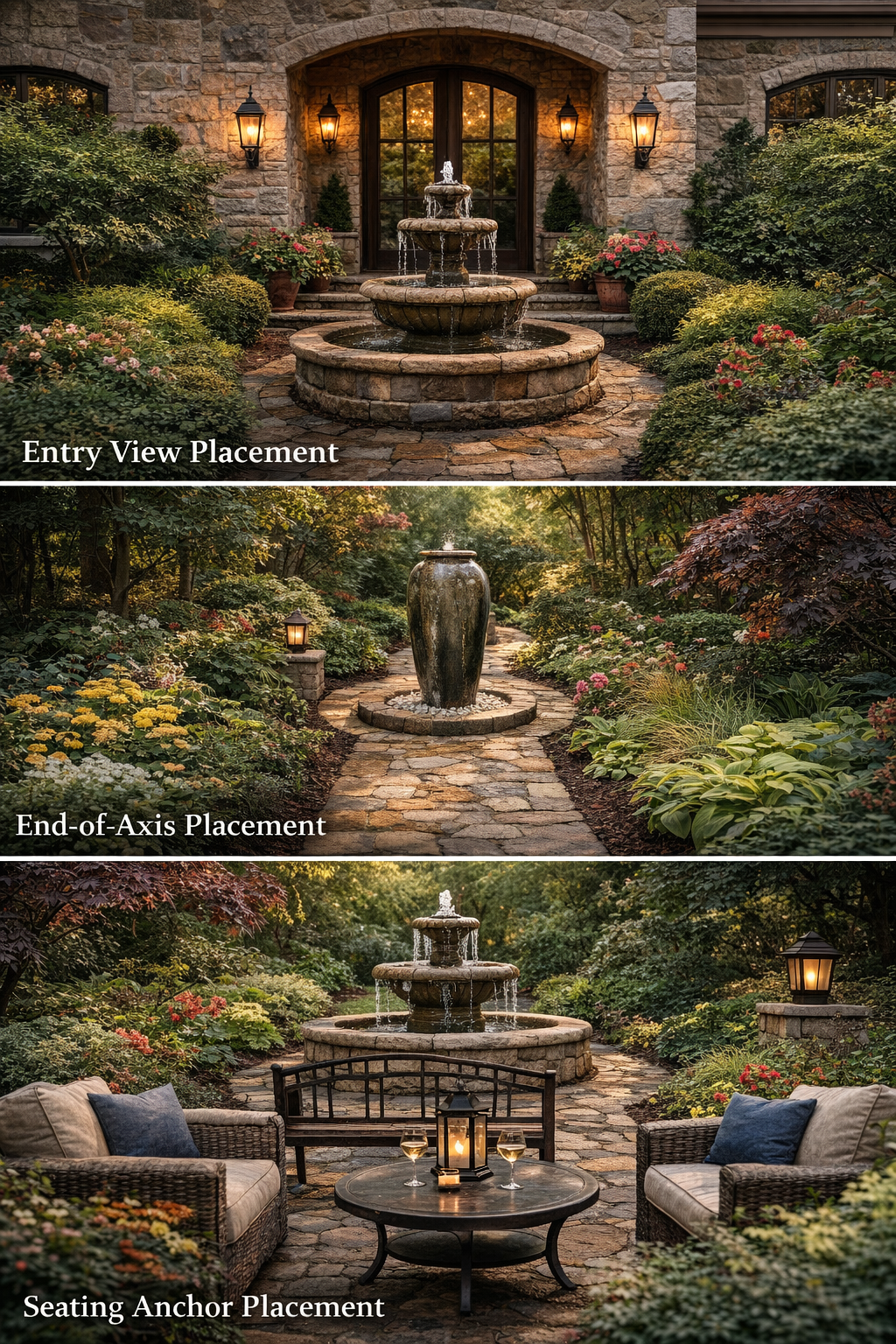
Here are the placements that consistently work:
Entry View Placement
Positioned where it’s visible from the home’s primary entrance or back door.
This creates:
- a welcoming focal point
- immediate sound therapy
- perceived home value improvement
End-of-Axis Placement
If you have a pathway, stepping stones, or a garden walkway, place the fountain at the end of it.
Your eye naturally follows lines.
A fountain at the visual destination feels professionally landscaped.
Seating Anchor Placement
Behind a bench, outdoor sofa, or bistro set.
This works especially well because water sound psychologically defines the seating area as a “retreat space.”
Step 6: Sound Considerations (Often Overlooked)
Size affects more than appearance — it affects how the water sounds.
- Smaller fountains → gentle trickle
- Medium tiered fountains → relaxing cascade
- Larger multi-tier fountains → masking sound (blocks street noise)
If your goal is to reduce neighbor or traffic noise, a slightly larger fountain is actually the correct choice.
Step 7: Final Checklist Before You Buy
Before clicking Add to Cart, confirm:
✔ You measured viewing distance
✔ You taped a cardboard footprint
✔ You checked walking clearance
✔ Basin width matches patio scale
✔ Height matches surrounding structures
✔ You chose placement intentionally
If all six are true, you can order confidently.
Why Getting the Size Right Matters
An outdoor fountain isn’t just a decoration. It changes how a space feels.
The right size creates:
- calm background sound
- visual focus
- a sense of permanence
- higher perceived property value
- a space people actually want to sit in
The wrong size becomes something people stop noticing after a week.
Sizing is the difference between “nice yard” and “wow, this place feels peaceful.”
And fortunately, with a tape measure and a piece of cardboard, you can get it exactly right the first time.